
What Commercial Cleaning
Actually Covers.
A plain-language guide to commercial cleaning: what the service is, what belongs in a contract, how a scope of works is written and priced, and the questions worth asking before you appoint a contractor.
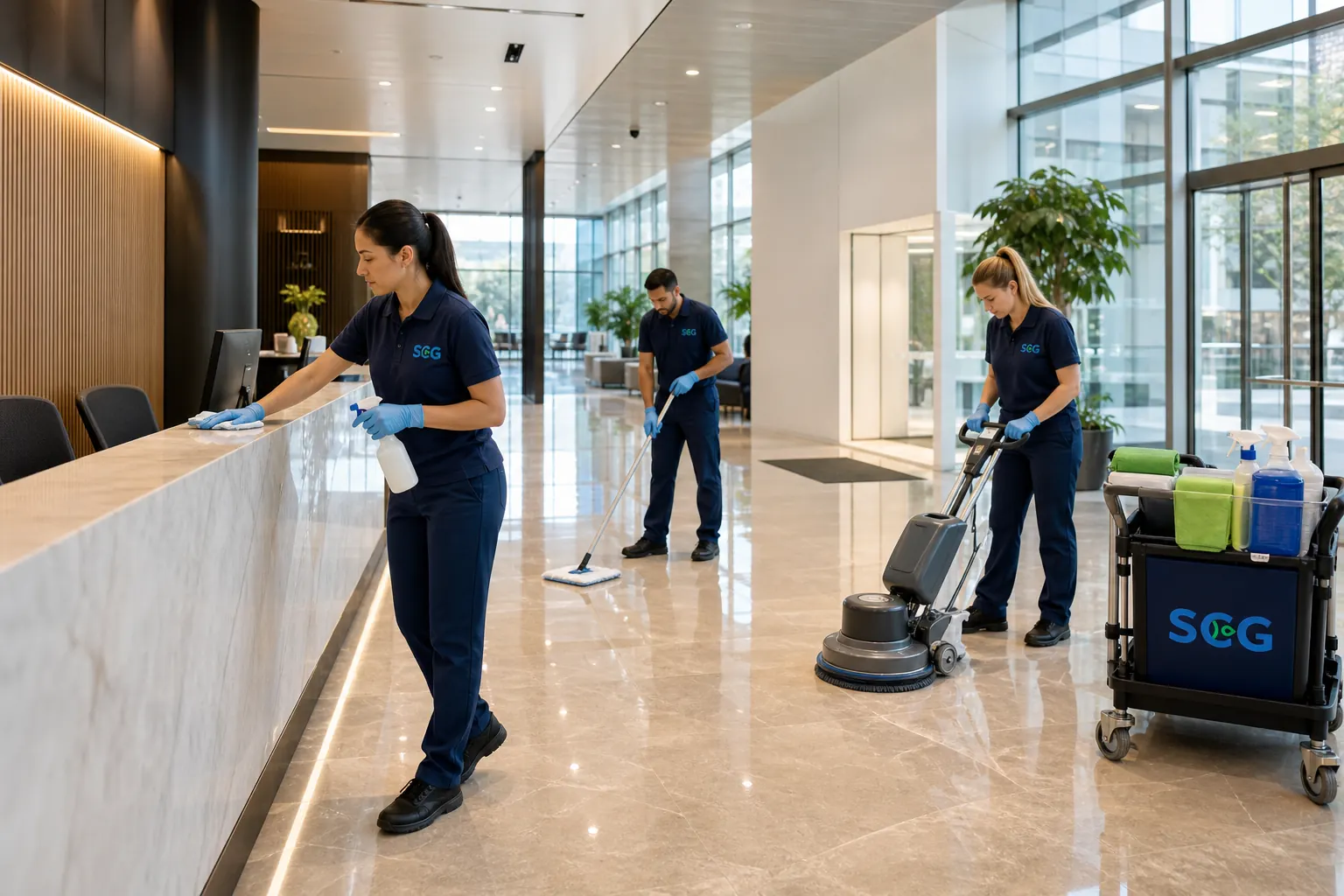
What commercial cleaning means
Looking to hire commercial cleaning in Sydney rather than just read about it? Sydney Clean Group covers all of Greater Sydney, is fully insured, and quotes are free and obligation-free — most sites can be walked through and quoted within 24-48 hours of your first call on 02 9139 8401. The rest of this page explains what commercial cleaning actually is and how it is priced, so you know what you are buying before you get a number.
Commercial cleaning is the contracted, scheduled cleaning of a workplace. It is defined by three things: it recurs to an agreed timetable rather than being booked ad hoc, it works to a written scope rather than to whatever the cleaner notices, and it is performed by an insured business rather than an individual. Everything else — the equipment, the products, the hours — follows from those three.
It is a different discipline to domestic cleaning, and the difference is not simply scale. Workplace surfaces are harder wearing and need machine work rather than hand work. Traffic is heavier and more predictable, so soil accumulates in known places. Compliance obligations are real: insurance certificates, safe work method statements and safety data sheets are documents a facilities manager will actually ask for. And the work almost always happens around someone else's operating hours.
The category covers a wide range of site types — offices, warehouses and distribution centres, strata and residential common property, medical and allied health suites, schools and childcare centres, gyms and studios, retail floors and community buildings. Each carries its own standard, its own regulator and its own inspection risk, which is why a single generic clean sold across all of them tends to satisfy none of them.
This page explains how the service works as a category. It deliberately does not try to sell you a specific programme.
Every one of these services is delivered under the same programme described on our commercial cleaning Sydney page, which sets out coverage, insurance and how we scope a site.
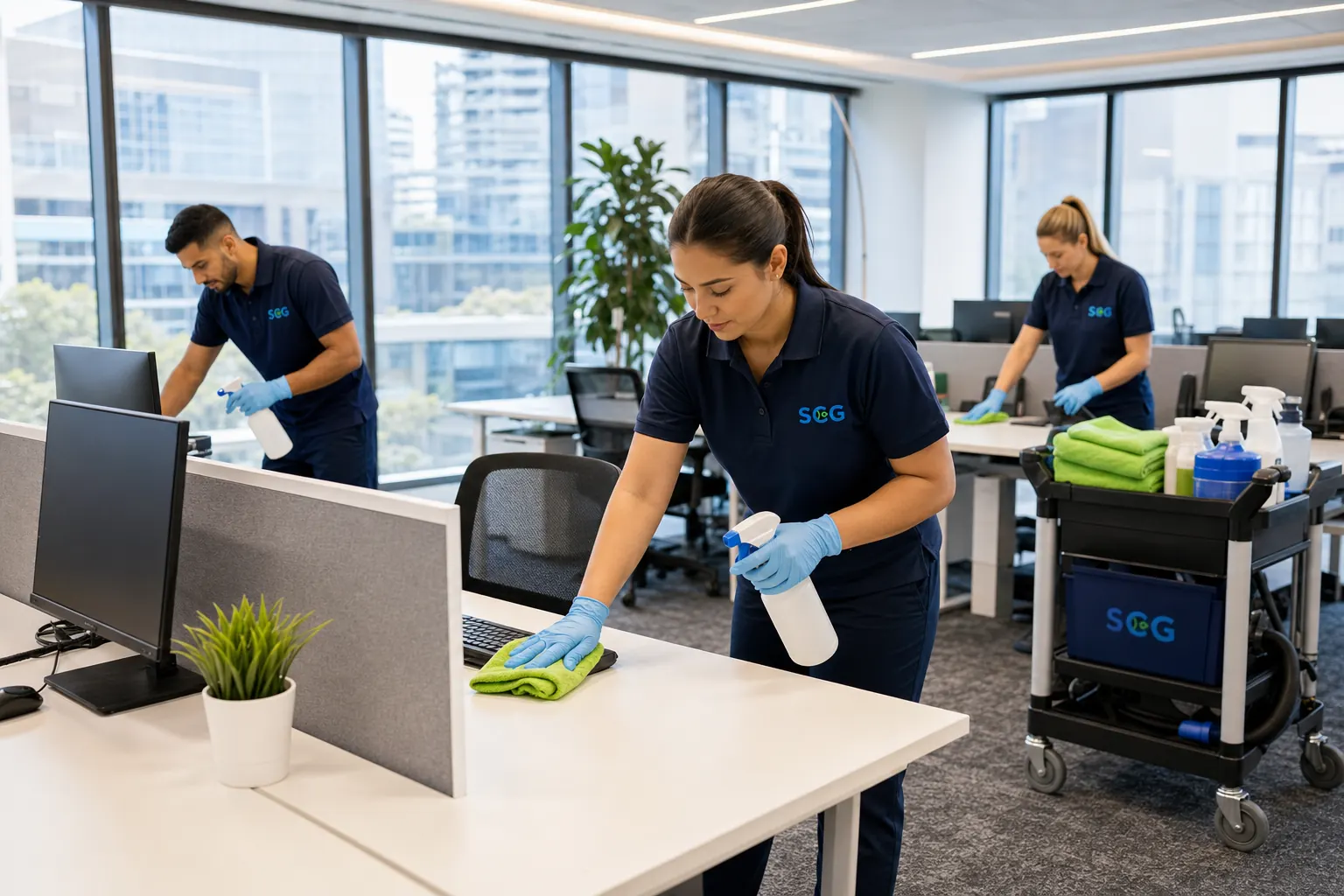
What a commercial cleaning contract includes.
Daily Cleaning
Dusting surfaces, vacuuming carpets, mopping floors, cleaning bathrooms, and regular waste disposal.
Deep Cleaning
Steam cleaning carpets, washing windows, and cleaning hard-to-reach areas on a scheduled basis.
Surface Disinfection
Sanitising commonly touched surfaces to reduce the spread of germs and maintain a healthy workplace.
Specialised Equipment
High-grade cleaning equipment and commercial-grade products designed for large-scale business environments.
Compliance & Standards
Adherence to health and safety standards, with staff trained in regulatory compliance for your industry.
Customised Plans
Tailored cleaning schedules and services built around your business hours, sector, and specific requirements.
Why businesses contract cleaning out.
Enhanced Professional Appearance
Conveys a professional image to clients and visitors — first impressions that reflect your brand values.
Improved Employee Wellbeing
Reduces the spread of diseases and minimises sick days — a healthier team is a more productive one.
Increased Productivity
Employees are more focused and motivated in a clean, organised environment — boosting overall output.
Long-term Cost Savings
Regular professional cleaning extends the lifespan of fixtures, furnishings, and flooring — protecting your investment.
What belongs in a scope of works
A scope of works is the document that turns a vague promise into a contract. It names every area of the site, every task performed in that area, and the frequency of each task. Reception, open-plan floor, meeting rooms, kitchen, washrooms, stairwell, dock, crib room — each gets its own list. Without it, cleaning is whatever the cleaner has time for on the night, and nobody can prove otherwise.
Frequencies matter as much as tasks. Bins emptied daily, hard floors mopped daily, carpet vacuumed daily in traffic lanes and fully weekly, high dusting monthly, carpet extraction six-monthly, hard-floor machine scrub quarterly. Written that way, everyone knows what should have happened on any given visit, and periodic work stops being something that will get done eventually.
The scope should also record what is excluded. Exterior windows above ground level, waste bin collection to the kerb, kitchen dishwashing, personal desk items, biohazard response and specialist plant cleaning are all commonly assumed to be included and commonly are not. Writing exclusions down is not defensive; it is what prevents the argument in month three.
Finally, the scope should name access conditions: keys, alarm codes, dock bookings, lift access, restricted areas, and what the cleaner does at the end of the shift. On a multi-tenant site, that section is frequently longer than the cleaning tasks themselves.
How commercial cleaning contracts are structured
Most commercial cleaning is sold as a periodic service charge — a fixed monthly or four-weekly fee covering the scheduled scope — with additional work quoted separately. Periodic tasks such as carpet extraction or floor sealing may be built into the monthly figure and delivered on a calendar, or quoted as they fall due. Both are legitimate; what matters is knowing which one you have signed.
Contract length varies widely across the market. Long lock-in terms with automatic rollover and exit fees are common, and they exist to protect the contractor rather than the client. A month-to-month agreement puts the pressure where it belongs: the contractor keeps the site by maintaining the standard, not by holding paperwork over you.
Watch how price increases are handled. A contract that allows unilateral annual increases without a corresponding change in scope is a contract that will get more expensive without getting better. Reasonable structures tie increases to award wage movements and state them in advance, with any scope change quoted separately.
Consumables are the other structural question. Hand soap, paper towel, toilet paper and bin liners can be supplied and charged by the contractor, or bought by the client and simply installed by the cleaner. Contractor supply is more convenient and stops the site running out; client supply is usually cheaper. Decide deliberately rather than discovering it on an invoice.
Comparing cleaning contractors: what to actually ask
Ask for the scope before the price. Any contractor can produce a lower number by quietly documenting less work, and a quote with no scope attached is not comparable to anything. When you are comparing three proposals, normalise them against a single scope you wrote, not against three different ones the contractors wrote for themselves.
Ask who performs the work. Large parts of the Australian cleaning market are subcontracted two or three layers deep, which is how a site ends up with a different unvetted person every fortnight and nobody accountable for the standard. Ask whether cleaners are directly engaged, whether they are police-checked, and what staff turnover looks like on comparable sites.
Ask to see current certificates of currency for public liability and workers compensation, plus safe work method statements for any higher-risk task on your site. A contractor who cannot produce these on request is a liability that sits with the building owner, not with the cleaner.
Ask how quality is measured. A monthly audit against the written checklist, a named contact rather than a call centre, and a stated rectification timeframe are the difference between a cleaning contract and a cleaning relationship. Then ask what happens when the standard slips twice — the answer tells you more than any reference will.
Common mistakes when buying cleaning services
The most expensive mistake is buying on hourly rate. Cleaning is bought by outcome, not by time, and an hourly comparison rewards the contractor who allocates the fewest hours. Two quotes at the same hourly rate can represent wildly different amounts of actual work, which is precisely why the scope has to come first.
The second is under-servicing floors to save money on the monthly invoice. Carpet that is not vacuumed frequently enough wears out years early because grit acts as an abrasive underfoot, and vinyl that is never machine scrubbed and resealed eventually needs stripping — an exercise that costs many times the maintenance it replaced. The cleaning line went down; the capital line went up.
The third is failing to plan the handover when changing contractors. Terminating the incumbent before the replacement has keys, codes, inductions and contractor-portal approval produces a week with no cleaner. Run the new contractor's onboarding in parallel and give notice only once access is arranged.
The fourth is treating the first month as settled. The standard on a new site is set in the first four weeks. Audit closely at the start, raise every deviation, and the habit forms correctly; leave it and you will be renegotiating a standard rather than enforcing one.
Commercial Cleaning — FAQs.
What is commercial cleaning?
Commercial cleaning is the contracted, scheduled cleaning of a workplace to a written scope of works, performed by an insured cleaning business. It covers offices, warehouses, strata common property, medical suites, schools, childcare centres, gyms, retail and community buildings. It differs from domestic cleaning in the equipment used, the compliance documentation required and the fact that it recurs to a timetable rather than being booked ad hoc.
What does a commercial cleaning contract usually include?
A typical contract includes daily or periodic cleaning of floors, workstations and shared areas, washroom and kitchen hygiene with consumable restocking, waste removal, and a periodic programme covering carpet extraction, hard-floor machine work, high dusting and internal glass. Everything included should be named in a scope of works with a stated frequency, and the exclusions should be written down as well.
How is commercial cleaning priced?
Price is built from the area to be cleaned, the floor finishes in it, the number of amenities, the site access conditions and the frequency of service. It is normally charged as a fixed periodic service fee with additional work quoted separately. A quote produced without a site inspection and a written scope is an estimate, and estimates are what turn into variation notices a few months into a contract.
How often should a workplace be cleaned?
Sites with daily occupancy and visible hygiene obligations — full-occupancy offices, medical suites, childcare centres, gyms and schools in term — generally need daily service. Hybrid offices commonly run three times a week. Low-traffic suites, storage-heavy warehouses and smaller strata blocks often work on a weekly or fortnightly visit paired with a scheduled periodic programme.
What is the difference between commercial and domestic cleaning?
Domestic cleaning is booked for a home, works to the occupant's preferences and uses hand tools and retail products. Commercial cleaning works to a documented scope, uses machine equipment sized to the site, carries insurance and safety documentation the client can request, and is scheduled around a business's operating hours. The skills overlap; the accountability and the equipment do not.
Should a commercial cleaning contract have a lock-in term?
It does not need one. Long lock-in terms with exit fees protect the contractor rather than the client, and a contractor confident in the standard of the work does not need a multi-year agreement to retain a site. Sydney Clean Group works month to month with no lock-in period and no exit fee, so the work is what keeps the contract in place.
What insurance and documents should a cleaning contractor provide?
At minimum, current certificates of currency for public liability and workers compensation, safe work method statements for any higher-risk task on the site such as working at height or machine operation, and safety data sheets for every chemical used. Police check confirmation for cleaners with unsupervised access is also standard. All of these should be supplied during onboarding rather than on request after an incident.
How do I compare quotes from different cleaning companies?
Write one scope of works yourself and ask every contractor to price that same document, rather than comparing three proposals that each describe different work. Then compare who performs the work, whether cleaners are directly engaged and police-checked, what insurance is held, how quality is audited, and what the rectification commitment is. Hourly rate on its own tells you almost nothing.
Where to go next.
Our Sydney-wide contract cleaning service: coverage, insurance, process and quoting.
How an office scope is built, and what nightly service covers in practice.
Industrial floor plant, racking dust and dock work in live logistics sites.
What a strata committee should expect from a common-property cleaning scope.
Two-stage clean-then-disinfect and the documentation clinics are asked for.
Trading-hours presentation and back-of-house standards for retailers.
Production floors, plant rooms and machinery surrounds in manufacturing.
Equipment sanitising, rubber floors and change rooms in fitness venues.
Term-time schedules, holiday periodics and campus access procedures.
Assessment-ready hygiene for early learning centres and preschools.
Detail cleaning between trades finishing and practical completion.
Extraction and encapsulation cycles that keep commercial carpet serviceable.
Dock bookings, concierge access and after-hours work in CBD towers.
Sanctuaries, pews, halls and parish offices cleaned around service times.
Local commercial cleaning specialists for Blacktown City's offices, retail and industrial sites.
Ready to put it in writing?
Free site walk, a written scope of works you approve before anything is priced, and a quote you can compare line by line. No obligation, no lock-in.