
Clean schools.
Better learning.
Professional school cleaning services that maintain a safe, healthy, and welcoming environment for students, staff, and visitors across Sydney.
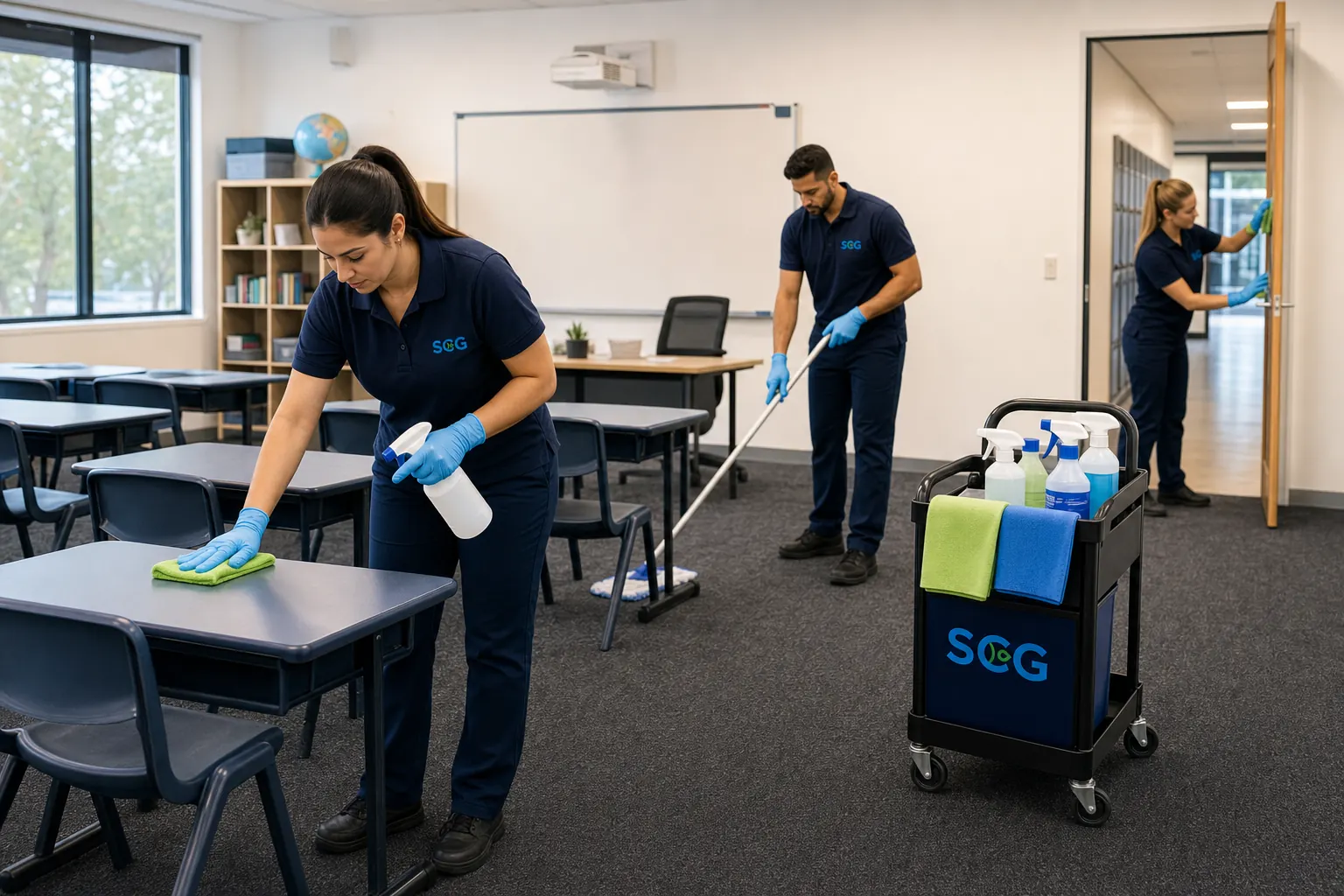
School Cleaning Services by Sydney Clean Group
School cleaning services play a crucial role in maintaining a safe and healthy learning environment for students, staff, and visitors. Given the high-traffic nature of educational facilities, it's essential to implement thorough and regular cleaning protocols that cater specifically to the needs of schools.
Professional school cleaning services play a vital role in achieving these objectives by implementing advanced cleaning techniques and adhering to strict sanitation standards.
By prioritising cleanliness, schools can create a more effective and welcoming educational environment — one that supports learning and instils confidence in parents and staff alike.
Schools with an attached preschool or out-of-school-hours service can add childcare and early learning cleaning to the same service schedule.
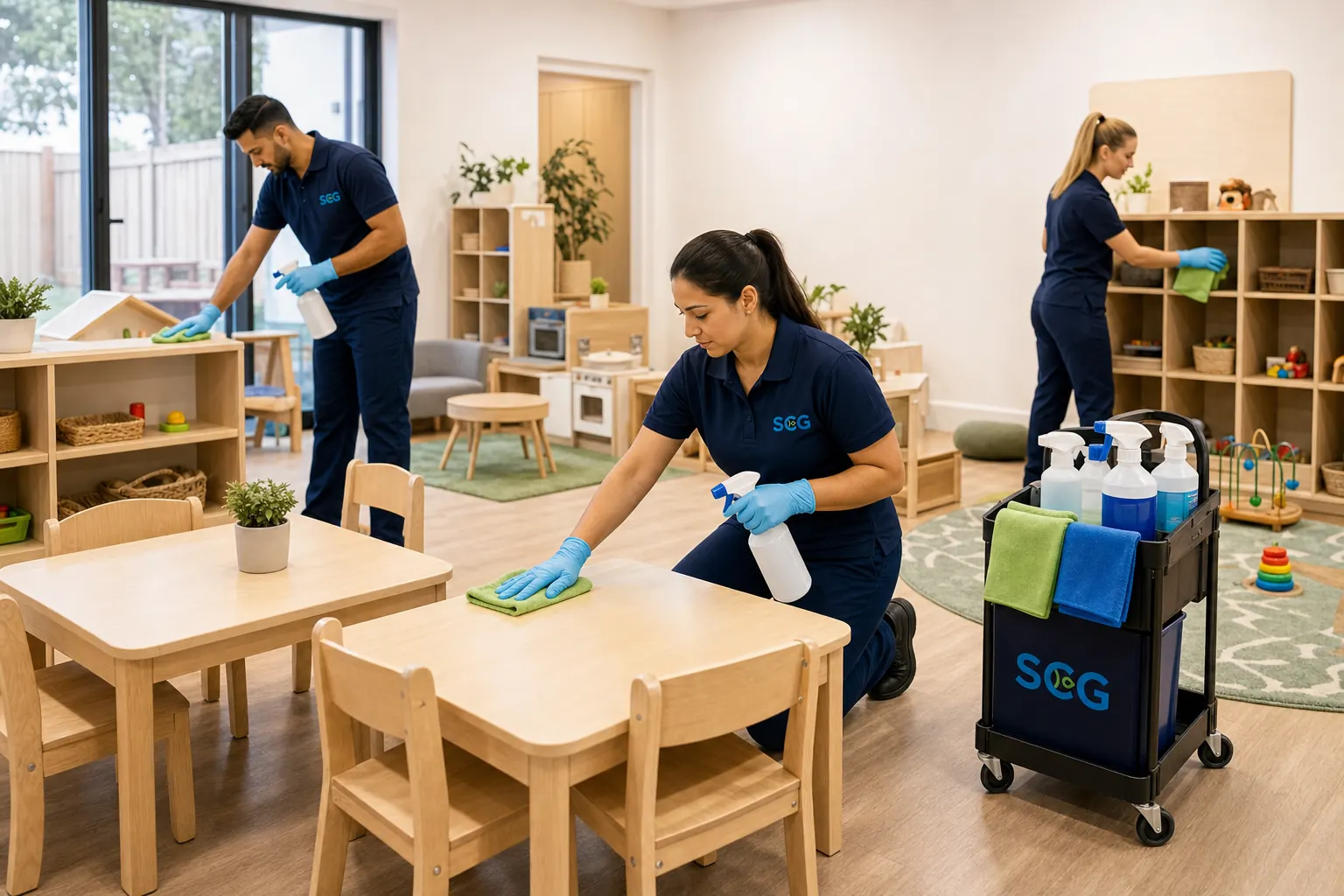
Every area of your school.
Classroom Cleaning
Regular sanitisation of desks, chairs, and educational tools to prevent the spread of germs. Special attention to high-touch surfaces like doorknobs, light switches, and whiteboard markers.
Corridors & Common Areas
Frequent sweeping, mopping, and disinfecting of high-traffic areas to maintain cleanliness and safety throughout the school.
Restroom Sanitisation
Thorough cleaning and disinfecting of restrooms multiple times daily to ensure hygiene standards are upheld — critical in preventing illness.
Cafeteria Cleaning
Cleaning and sanitising tables, chairs, and surfaces before and after meals to ensure a hygienic dining area for students and staff.
Non-Toxic Cleaning Agents
Schools use eco-friendly and non-toxic cleaning products to safeguard children's health and minimise environmental impact.
Seasonal Deep Cleaning
During school breaks, deep cleaning activities including carpet cleaning, window washing, and detailed sanitisation of all areas are conducted.
Why schools choose us.
Enhanced Health & Safety
A clean school environment reduces the presence of germs and bacteria, lowering the risk of outbreaks and keeping absenteeism to a minimum.
Improved Learning Environment
Students and teachers are more likely to be productive and engaged in a clean and well-maintained environment.
Compliance with Regulations
Professional cleaning services ensure that schools meet health and safety regulations and standards required by educational authorities.
Peace of Mind for Parents & Staff
Knowing that the school is consistently maintained to high standards provides reassurance to parents and enhances working conditions for staff.
What a school cleaning scope covers, area by area
Classrooms are the core of the scope: bins emptied, floors vacuumed or mopped, desks and chairs wiped, touchpoints disinfected, whiteboards and trays cleaned, and sinks in craft and science rooms cleared. Furniture is moved on a rotation so the floor underneath is not permanently skipped.
Toilets and change rooms carry the highest frequency and the tightest process. Pans, urinals, basins, taps, cubicle partitions, mirrors and floors are cleaned with dedicated colour-coded equipment, and consumables are restocked every visit rather than when somebody reports they have run out.
Beyond that sit canteens and food areas, halls and gymnasiums, corridors and stairwells, staff rooms and administration offices, libraries, and external hard surfaces such as covered walkways and playground concrete. Each needs a stated frequency in the scope: a hall used for assemblies, sport and after-hours hire is not on the same cycle as a library.
After-hours scheduling around students and staff
Almost all school cleaning happens outside teaching hours. The practical reason is access — a classroom cannot be properly cleaned with thirty students in it — but the safety reason matters more. Fewer adults on site during the day means simpler supervision and less contact between contractors and students.
A typical pattern is an afternoon and evening service starting after the last bell, covering classrooms, toilets, corridors and offices, with a short early-morning run for anything that needs to be presentable at 8am. Weekend work is reserved for periodic tasks that need drying time or generate noise.
Where the site is used after hours — community hire, out-of-school-hours care, evening sport in the hall — the schedule has to work around bookings rather than assume an empty building. That belongs in the written service schedule, not sorted out by phone each week.
Term-time service versus holiday deep-clean cycles
Term-time cleaning is about consistency: the same rooms, the same standard, every day, with enough capacity to absorb spills, illness and events without falling behind. It is deliberately not deep cleaning, because during term there is no window for it.
The holiday programme is where the building gets restored. Vinyl floors are stripped and resealed, carpets extracted, classrooms detailed including inside storage and under fixed furniture, canteens and change rooms deep cleaned, high-level dusting and light diffusers cleared, and internal glass done properly.
The constraint is the calendar, not capability. Every school has the same short break, and floor sealing needs cure time before furniture goes back in. Scoping the holiday programme a term ahead is the difference between getting the full list done and getting half of it.
Working with Children Checks, inductions and site access
Child-related work in New South Wales requires a valid Working with Children Check, and a school is entitled to sight and verify it for every person who attends. The practical question for a principal or business manager is not whether a contractor says their staff are cleared, but how they track expiry dates and how they handle a last-minute replacement cleaner.
Site induction is the second layer: keys and alarm codes, which areas are restricted, where chemicals are stored, evacuation procedures, and who to contact after hours. A contractor that inducts every attending staff member, including relief staff, is the one that will not create a problem on a Friday night.
Sydney Clean Group staff are background-checked and inducted to each site before they attend, and we are happy to provide clearance details to the school for verification.
Infection control in classrooms, toilets and change rooms
Infection control in a school is mostly a discipline problem rather than a chemistry problem. Colour-coded cloths and mop heads stop equipment moving between toilets and classrooms. Surfaces are cleaned first and disinfected second, because disinfectant applied over soil achieves very little.
Touchpoints do the heavy lifting: door handles and push plates, light switches, tap handles, bubbler buttons, handrails, shared keyboards and tablets, and the backs of chairs. These are the surfaces where frequency changes outcomes, and they are the first thing to increase when a gastro or flu run moves through a year group.
Product choice matters for a different reason. Schools want low-odour, low-residue products that are safe around children and do not leave a chemical smell in a closed classroom overnight, which rules out a lot of what works acceptably in an empty office tower.
How to compare school cleaning contractors
Ask for the scope with frequencies against every area, and check that the periodic programme is written down with the holiday cycle named. A quote that prices “daily cleaning” without a room list cannot be compared and cannot be enforced.
Confirm Working with Children Checks, public liability and workers compensation, then ask how staff continuity is handled. Schools benefit more than most sites from the same team attending, because knowing which rooms are used for what saves time on every single visit.
Then ask about escalation. Who is called when a toilet block fails on a Monday morning, and how quickly does someone attend? Sydney Clean Group works with schools across Greater Sydney on term and holiday programmes — call 02 9139 8401 to arrange a site walk and a free written quote.
School Cleaning — FAQs.
What does a school cleaning contract usually cover?
Most contracts split into a daily service and a periodic programme. The daily service covers classrooms, corridors, toilets, staff rooms, canteen or food areas and administration offices — bins, floors, touchpoints and consumables. The periodic programme handles hard floor stripping and sealing, carpet extraction, window cleaning, high dusting, hall floors and playground hard surfaces, scheduled around term breaks.
Do school cleaners need a Working with Children Check?
Anyone engaged in child-related work in New South Wales needs a valid Working with Children Check, and schools are entitled to verify it. Ask any contractor how they track clearances, how they handle staff changes, and how contractors are signed in and supervised on site. Sydney Clean Group staff are background-checked and inducted to each site's access and supervision requirements before they start.
Can school cleaning be done after hours so students are not disrupted?
Yes, and it is the normal arrangement. Most school cleaning runs after the last bell, with the team working through classrooms, corridors and toilets while the site is empty. An early-morning service covers anything that needs to be fresh at the start of the day. Where cleaning must happen during hours, such as canteen turnarounds or spills, it is scheduled around timetabled use of that space.
How is classroom cleaning different from office cleaning?
Classrooms have far more touchpoints per square metre than an office and a much higher rate of contact between them. Desks, chairs, shared devices, door handles, light switches, tap handles and whiteboard trays are handled by dozens of different people a day. Floors take more soil from playgrounds, and craft, food and art rooms create loads an office never sees. Frequency and product selection both change as a result.
What cleaning happens during school holidays?
Holidays are when the work that cannot happen during term gets done. That usually means stripping and sealing vinyl floors, carpet extraction, detailing classrooms including inside cupboards and under furniture, deep cleaning canteens and change rooms, high-level dusting, light diffusers and internal window cleaning. Booking the holiday programme early matters because the window is fixed and every school wants the same weeks.
How do you handle infection control in shared spaces?
Shared spaces are managed by frequency and sequence rather than stronger chemicals. Toilets, change rooms and high-touch surfaces are cleaned on a set cycle with colour-coded cloths and equipment so nothing moves between a toilet and a classroom. Surfaces are cleaned before they are disinfected, because disinfectant sitting on top of soil does very little. During an outbreak the touchpoint frequency increases rather than the process changing.
How is school cleaning priced?
Pricing is built from cleanable area, the number of classrooms and toilet blocks, service frequency, and the size of the periodic programme. Canteens, halls, gymnasiums and change rooms add labour. The honest way to compare quotes is to ask each contractor for the hours per visit and the periodic schedule in writing. Sydney Clean Group quotes schools free of charge after a site walk.
Related education and care cleaning.
Local school cleaning crews across Greater Sydney.
Early learning and preschool cleaning with the same clearances.
Infection control cleaning for clinics and health rooms.
Administration blocks, staff rooms and campus offices.
Office, retail and campus-adjacent cleaning across Hornsby, home to one of Sydney's densest school and TAFE clusters.
Get Started Today
Contact us today to schedule a free consultation and discover how our cleaning services can benefit you. Let us handle the cleaning so you can focus on what matters most.