
Church Cleaning Sydney.
Sacred spaces, spotlessly kept.
Respectful, professional cleaning for churches and places of worship across Sydney — handled with the care, discretion, and attention that sacred spaces deserve.
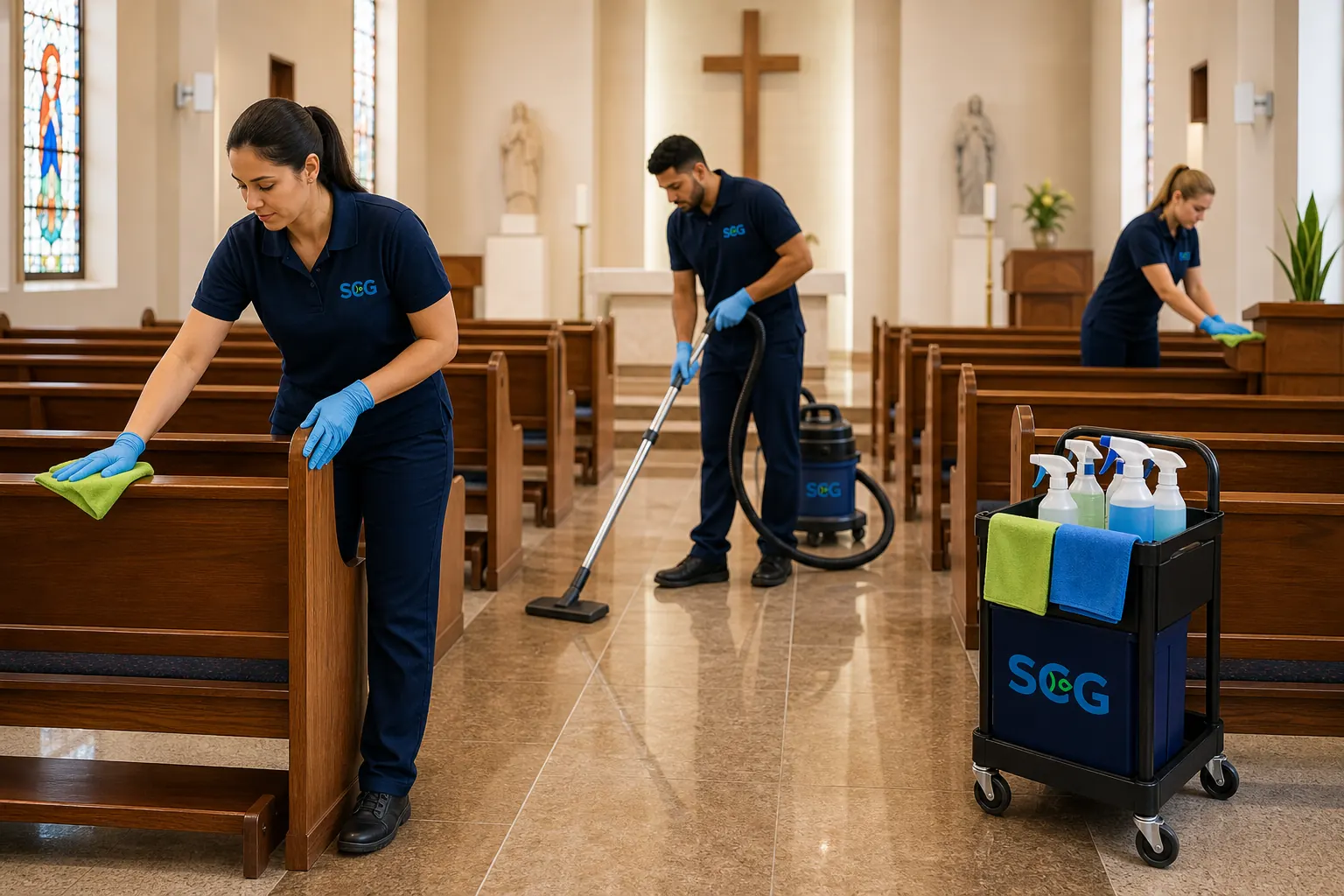
Church Cleaning Services by Sydney Clean Group
Church cleaning in Sydney requires more than just technical skill — it demands respect for the spiritual significance of the space and the community it serves. Sydney Clean Group covers parishes across all of Greater Sydney, is fully insured, and provides a free, no-obligation quote — most churches can be walked through and quoted within a few days of your call on 02 9139 8401.
Our cleaners are trained to work in environments that require respect, discretion, and careful attention to delicate features such as stained glass, wooden pews, altars, and heritage fixtures.
We schedule cleaning at times that don't interfere with services, events, or worship activities — so your congregation always arrives to a clean, welcoming space.
Parishes running halls, offices or community facilities can extend the scope through our commercial cleaning team in Sydney.
Every area of your church.
Sanctuary Cleaning
Meticulous cleaning of pews, altars, pulpits, and all sanctuary areas — with utmost respect for sacred items.
Stained Glass & Fixtures
Careful cleaning of delicate stained glass windows and lighting fixtures using safe, heritage-appropriate methods.
Floor Maintenance
Appropriate cleaning methods for carpet, timber, stone, and tile flooring — preserving each material's character.
Restrooms & Amenities
Regular thorough cleaning of restrooms, corridors, and amenity areas used by congregation members.
Fellowship Halls & Kitchens
Cleaning of fellowship halls, meeting rooms, and church kitchens used for community events and gatherings.
Event Clean-ups
Post-event cleaning after services, weddings, funerals, and community gatherings — ready for what's next.
Why churches trust us.
Enhanced Worship Experience
A clean, well-maintained environment enhances the spiritual experience for your entire congregation.
Heritage Preservation
Proper cleaning methods preserve and protect historical architectural features, furnishings, and artworks.
Community Health
Reduces allergens, dust, and bacteria — creating a healthier environment for all who gather.
Community Confidence
A clean, well-kept church builds pride among members and creates a welcoming space for visitors.
Cleaning around a weekly service schedule
A church is one of the few buildings where the cleaning window is dictated almost entirely by the calendar rather than by business hours. The nave has to be presentable before the first service, and whatever happened in it on Sunday afternoon has to be dealt with before a midweek group uses the same space. Most parishes we work with settle on a main clean early in the week and a lighter reset late in the week, with the timing fixed rather than approximate.
That schedule needs to survive the exceptions. Feast days, baptisms, confirmations, carol services and the whole of Holy Week and Christmas change both the volume of people through the building and the state it is left in. We agree the recurring pattern first, then build in the peaks, so the parish office is not making a phone call every time the liturgical calendar gets busy.
Weddings and funerals are the two that cannot be treated as routine. A funeral often means flowers, candle wax, a full church and a wake in the hall, sometimes at short notice and always at a moment when nobody in the parish has attention to spare for cleaning logistics. A wedding usually means confetti, decorations pinned to pew ends, and a hard deadline before the next service. Both are scoped as their own visit, with the reset done afterwards rather than absorbed into the next scheduled clean.
Pew and timber care
Church pew cleaning is where the most damage gets done by well-meaning effort. Pews are usually solid timber, often oiled or shellacked rather than modern polyurethane, frequently more than a century old, and thoroughly unsuited to the multi-purpose spray that works fine on an office desk. Silicone polishes build a film that dulls over time and complicates any future restoration, and excess water lifts grain and loosens joints.
Our approach is dry dusting as the default, damp wiping with a barely-moist cloth and a neutral pH cleaner where there is actual soiling, and immediate drying afterwards. Attention goes to the places that are genuinely dirty rather than the places that are easy to reach: the top rail where hands rest, the back of the pew in front, book ledges, hymnal racks and kneelers, and the underside edge where chewing gum and dust collect.
Candle wax on timber or stone is treated separately and gently, lifted rather than scraped. Brass, pulpit fittings and memorial plaques are cleaned as agreed with the parish, because many older pieces carry a patina that the congregation values and that an aggressive metal polish removes permanently. Where a fitting is heritage-listed or restored, we ask before we touch it.
Carpet, aisle runners and the nave floor
The centre aisle of a church takes a load that has almost no equivalent in commercial cleaning: every person in the building walks the same narrow line, twice, in the same twenty minutes. The result is a traffic lane that darkens years before the carpet either side of it, and a runner that wears through at the entrance end first.
Aisle runners and nave carpet respond well to being treated on their own cycle rather than being included in a whole-floor clean. Regular vacuuming of the lane, spot treatment, and periodic hot water extraction of the runner and the first few metres inside the doors will keep the whole floor looking consistent for a fraction of the cost of replacing a runner. Church buildings frequently combine carpet in the nave with stone or timber in the sanctuary and vinyl in the hall, and each surface needs its own method rather than one mop.
Confetti, order-of-service paper, candle drip and the gravel walked in from an unsealed car park are the four recurring offenders. None of them are hard to deal with promptly and all of them are difficult once they have been ground in for a fortnight.
Halls, parish offices and church-run playgroups
For many parishes the hall is busier than the church. Scouts, twelve-step meetings, community choirs, ESL classes, polling booths and hall hire to outside groups mean the space turns over constantly, and the cleaning question is usually about resetting between users rather than deep cleaning. A clear standard for how the hall should be left, plus a scheduled reset, prevents the slow accumulation that otherwise lands on a volunteer.
Parish offices are small commercial spaces with real requirements: desks, meeting rooms where pastoral conversations happen, a staff kitchen, and records that must not be disturbed. We clean around confidential paperwork rather than tidying it, and we agree in advance which surfaces are ours to touch.
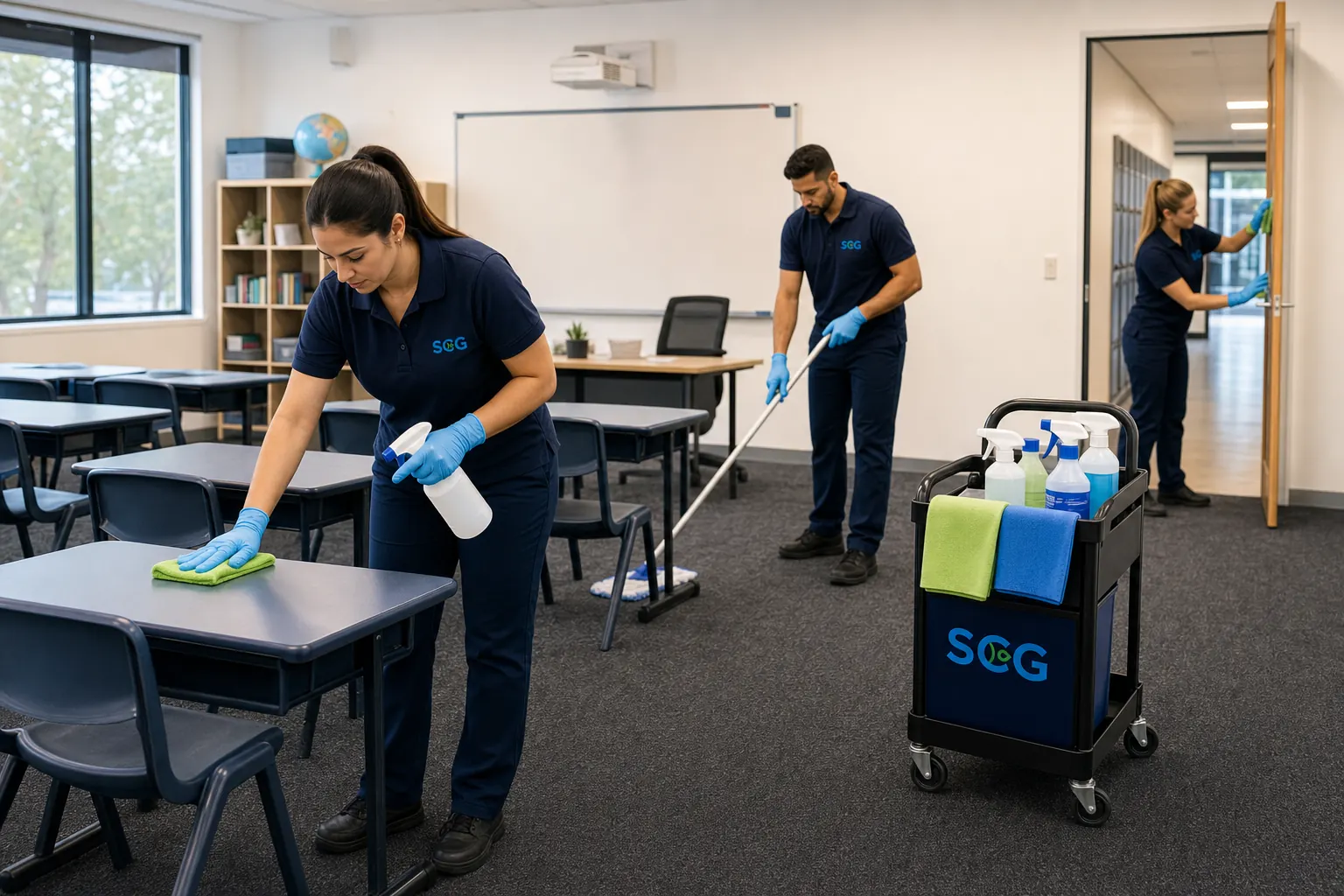
Church-run playgroups, preschools and long day care centres carry a different obligation again, with regulated hygiene standards for nappy change areas, sleep rooms, toys and low-level surfaces. Where a parish operates one on site we scope it separately under our approach to early learning centres — see our page on childcare centre cleaning below. Parish primary schools sit in the same category and are handled under our school cleaning scope.
Kitchens used for community catering
Church kitchens are frequently the least understood room in the building. A kitchen that produces morning tea for two hundred people after a service, a weekly community meal, or catering for a funeral wake is doing genuine food-service work, often in a domestic-style room fitted out decades ago and staffed by rotating volunteers.
The cleaning implications are practical rather than dramatic: degreasing behind and under equipment, cleaning range hood filters and splashbacks properly, sanitising benches and sinks used for food preparation, keeping the floor free of the grease film that makes tiles slippery, and emptying and cleaning bins so the room is not the reason the hall smells. Fridges and urns need scheduled attention because no volunteer roster reliably owns them.
Where a parish is preparing and serving food to the public, local council requirements can apply, and a documented cleaning schedule is far easier to point at than a memory of who did what. We write the scope down for exactly that reason.
Sacred spaces, and how volunteers and contract cleaners fit together
There are areas of a church where cleaning is not a purely practical question. The sanctuary, altar, tabernacle, font, sacristy and anything holding consecrated elements are governed by the parish's own practice, and the correct behaviour for a cleaner is to ask, follow the instruction exactly, and not improvise. In most parishes we work with, cleaners maintain the surrounding areas while designated members of the congregation attend to the altar and the vessels themselves. We are comfortable with that boundary and we brief our staff on it before their first visit.
The same care applies to memorials, honour rolls, donated furnishings and anything with a plaque on it. Objects that look ordinary to an outsider often carry real significance to the congregation, and moving one to clean behind it without asking is the fastest way to cause offence in an otherwise excellent working relationship.
Most parishes end up with a mix of a volunteer cleaning ministry and a contract cleaner, and that mix works well when the split is written down. Volunteers are usually best at the frequent, light, custodial tasks — tidying after a service, resetting chairs, watching the flowers. Contract cleaning covers the parts that need equipment, consistency or a duty of care the parish should not place on a volunteer: restrooms, kitchen degreasing, floor machinery, carpet extraction, height work and anything involving chemicals. Sydney Clean Group is at 77 Garfield Street, Wentworthville NSW 2145, and we clean churches across Greater Sydney. Call 02 9139 8401 to talk through a scope.
Church Cleaning — FAQs.
What does a church cleaning service include?
A typical church cleaning scope covers the nave and sanctuary areas, pews and hymnal racks, entry and aisle carpet, restrooms, the hall and meeting rooms, the parish office, and the kitchen. Vestries, sacristies and anything on or around the altar are cleaned only as the parish directs. We write the scope down per building rather than working from a generic checklist.
How do you clean church pews without damaging the timber?
Dry dusting is the default. Where there is real soiling we use a barely-damp cloth with a neutral pH cleaner and dry immediately. We avoid silicone polishes, which build a film that dulls the timber and complicates future restoration, and we avoid excess water, which lifts grain and loosens old joints. Candle wax is lifted gently rather than scraped.
Do you have church cleaners near me in Sydney?
We clean churches across Greater Sydney, from the CBD and inner suburbs out through Parramatta, Blacktown, Penrith, Liverpool and Campbelltown, and across the north shore, eastern suburbs and Sutherland Shire. Our office is at 77 Garfield Street, Wentworthville NSW 2145. Call 02 9139 8401 and we will tell you plainly whether your parish is in an area we service well.
Can you clean around our service times, weddings and funerals?
Yes, and it is the normal arrangement. Most parishes use a main clean early in the week and a lighter reset before the weekend, with the timing fixed. Weddings and funerals are scoped as their own visit because confetti, flowers, candle wax and a full hall afterwards are not something to absorb into a routine clean, often at short notice.
Should our church use a volunteer cleaning ministry or a cleaning company?
Most parishes are best served by both, with the split written down. Volunteers handle frequent light tasks such as tidying after a service and resetting chairs. A contract cleaner covers what needs equipment, consistency or a duty of care a parish should not place on a volunteer: restrooms, kitchen degreasing, floor machinery, carpet extraction and height work.
Do you clean church halls, parish offices and preschools?
Yes. Halls hired out to community groups are reset on a schedule so the load does not fall on volunteers. Parish offices are cleaned as small commercial spaces, working around confidential paperwork rather than tidying it. Church-run playgroups, preschools and parish schools are scoped separately against the hygiene standards those settings require.
Do you work with churches of all denominations?
Yes. We clean Catholic, Anglican, Uniting, Orthodox, Baptist and independent congregations, along with other places of worship. Practice around the sanctuary and sacred objects differs considerably between traditions, so we ask the parish for its own instructions at setup, brief our cleaners on them, and follow them exactly rather than assuming.
How much does church cleaning cost in Sydney?
Cost depends on the size of the church, hall and offices, the frequency you need, and whether heritage fixtures need special handling. We quote from a free, no-obligation walk-through rather than a phone estimate, so the price reflects your building rather than a generic rate. Call 02 9139 8401 for a quote.
How quickly can you start cleaning our church?
Most parishes can be walked through, scoped and quoted within a few days of the first call, and we can usually start within a week once a scope is agreed. If you have an urgent need — a funeral, a wedding, or a one-off event clean — tell us on the call and we will prioritise it.
Related services for parishes.
For parish playgroups, preschools and long day care rooms.
Parish schools, classrooms, canteens and staff rooms.
Extraction for aisle runners, nave carpet and hall floors.
Desks, meeting rooms and staff kitchens on a set schedule.
Your congregation deserves a clean church.
Free quotes, no obligation. We'll schedule cleaning around your services and events — with the respect your church deserves.