
Carpet Steam Cleaning
Sydney.
A technical guide to hot water extraction specifically — how the equipment works, what it removes that vacuuming can't, the science behind drying times, when steam is the wrong choice, and how carpet tile differs from broadloom.
The method, explained properly.
This page is a deep dive into one specific method — hot water extraction, which is what almost everyone in Sydney means by carpet steam cleaning. If you're after our general carpet service, booking information or a quote, that's covered on our carpet cleaning page. This page exists because the method itself is widely misunderstood, and understanding it helps you ask a cleaner the right questions.
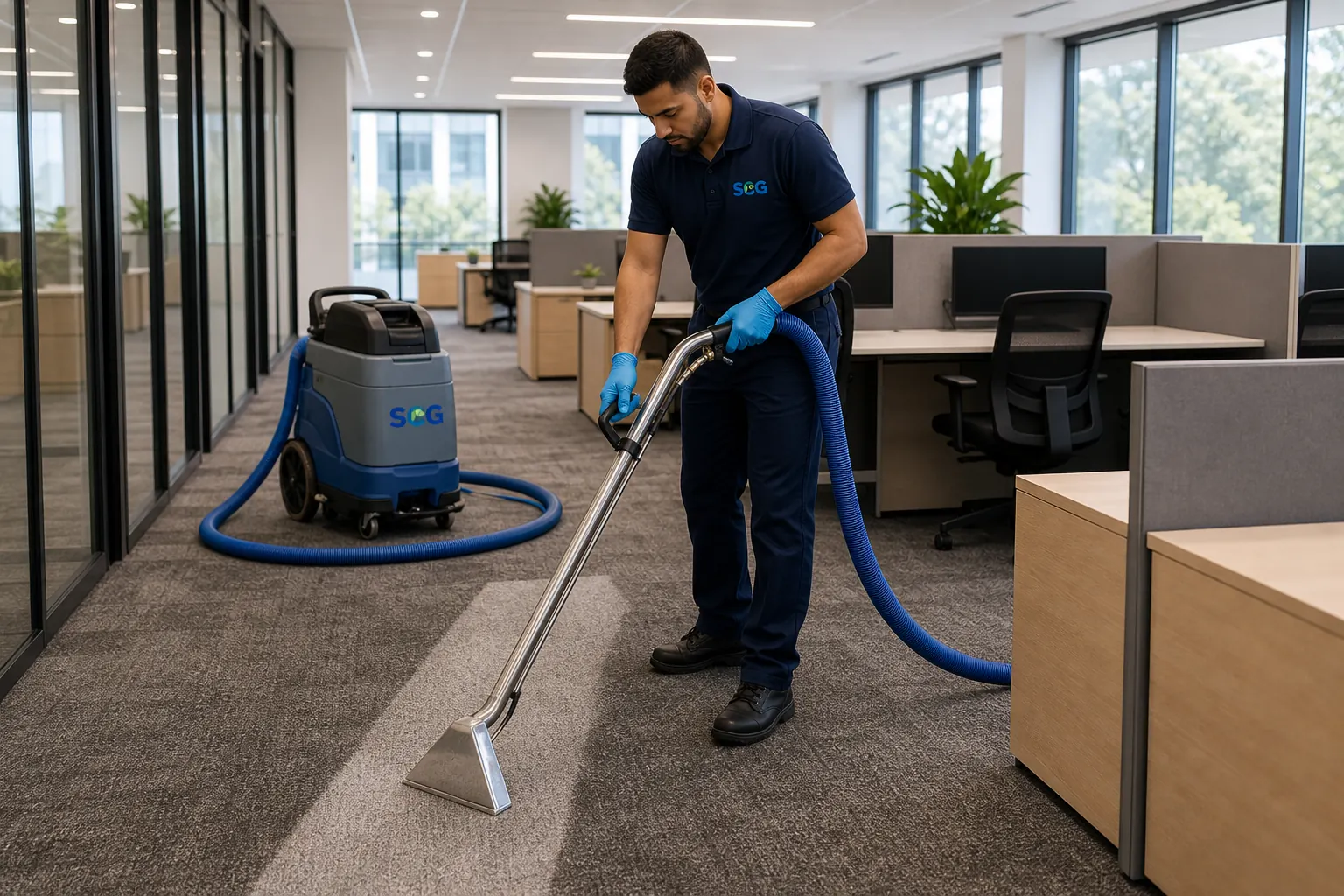
Hot water extraction uses a pump to force heated water and a cleaning solution into the carpet pile under pressure, an agitation head to work it down to the base of the fibre, and a powerful vacuum to draw the solution straight back out along with the suspended soil — all in close to the same motion. Truck-mounted units run at higher water temperature and vacuum pressure than portable units, which is why a truck-mount typically leaves a carpet drier and cleaner in one pass than a portable machine achieves in two.
It is not steam in the literal sense — water in the tank rarely exceeds 90–95°C and never boils on the carpet itself. The heat's job is to soften oils and body soils bonded to the fibre so the extraction pass can lift them, which is why a lukewarm or cold-water pass, however strong the suction, leaves a measurably dirtier carpet.
For pricing, availability and to book a general residential or office carpet clean, book a general carpet clean for your home or office covers the service end to end.
What the method actually addresses.
Deep Soil Below The Surface
Grit, skin cells, body oils and dust mite matter that settles in the bottom third of the pile, well past where a vacuum's airflow reaches.
Detergent Residue
The soapy film left behind by supermarket spot cleaners and rental machines, which itself attracts soil and causes rapid re-soiling if not flushed out.
Odour Bonded To The Pile
Smoke and general staleness sitting in the fibre, as distinct from odour that has migrated into the underlay, which extraction alone can't reach.
Allergen Load
Dust mite matter and pollen trapped in the pile, reduced substantially by the combination of heat, agitation and extraction.
Traffic-Lane Soiling
The fine, greasy soil that builds evenly along walkways in commercial carpet, distinct from the localised spills common in homes.
Carpet Tile & Broadloom, Differently
A method adjusted for the backing and construction differences between commercial carpet tile and residential broadloom.
Why the method matters more than the marketing term.
Manufacturer-Specified Method
Hot water extraction is the periodic deep-clean method most carpet manufacturers specify to preserve warranty conditions.
Reaches What Vacuuming Can't
Pressure and heat move soil out of the base of the pile rather than just the surface fibres a domestic vacuum touches.
Equipment Matched To The Job
Truck-mounted units for maximum extraction where access allows, portable units for high-rise and restricted-access sites.
Honest About Limits
We tell you plainly when steam is the wrong method for a fibre or a fault, rather than running the same process on everything.
Truck-mounted versus portable extraction
A truck-mounted unit sits in a van outside and runs hoses in through a window or door, using the vehicle's own engine to generate far higher water temperature and vacuum pressure than any portable machine can match. That extra pressure means more water and soil pulled out per pass, which translates directly into a faster drying time and a more thorough clean.
Portable units carry their own heater and vacuum motor into the building, which is the only option for high-rise apartments and office tenancies where a hose run from street level isn't practical. A quality portable unit still performs genuine hot water extraction — it just does so at lower pressure and temperature than a truck-mount, which is why commercial high-rise carpet sometimes needs a slightly longer dwell time or a second pass to match a ground-floor result.
What steam removes that a vacuum physically cannot
A domestic vacuum, even a good one, moves air across the top of the pile and lifts loose particles sitting near the surface. It does nothing to soil that has worked its way down and bonded to the fibre with body oils and moisture over months of foot traffic — and it does nothing at all to the soapy residue left behind by a supermarket spot cleaner, which is worth naming specifically because that film is often the reason a spot-cleaned patch re-soils faster than the carpet around it.
Heat is doing real chemical work here, not just comfort. Body oils and many common soils soften measurably above roughly 60°C, which is why hot water reaches soil that cold water and agitation alone leave behind. The extraction step then has to be strong enough to pull that softened soil and the water carrying it straight back out, rather than pushing it deeper — which is the difference between professional equipment and a rental machine with a weaker vacuum motor.
Drying science: airflow, humidity and why fans matter more than time
Drying is fundamentally about moving humid air away from the wet fibre and replacing it with drier air, not simply waiting. A closed-up room with still air can take genuinely twice as long to dry as the same carpet with cross-ventilation or a fan moving air across the surface, because the air immediately above the pile becomes saturated and stops accepting more moisture until it's exchanged.
That's why technicians finish with a dry-stroke pass — a final extraction stroke with no water applied, purely to pull residual moisture back out — and why opening windows on opposite sides of a room genuinely does more than opening one window on a still day. Wool and thick cut-pile hold more water by volume and sit at the longer end of any drying estimate regardless of airflow; low-pile carpet tile dries fastest because there's simply less fibre volume to hold water in the first place.
When hot water extraction is the wrong choice
Some natural-fibre floor coverings — sisal, seagrass and some jute-backed products — are genuinely damaged by water-based extraction, because the fibre itself absorbs moisture and can shrink, discolour or brown as it dries. These need a dry compound or a specialist method entirely, and applying hot water extraction to them is a mistake regardless of how gently it's done.
Carpet with a jute secondary backing, common in older wool carpet, is also a caution: excess water reaching the jute can cause it to shrink and pull the carpet away from the gripper rods at the wall edge, known as delamination or de-tufting in severe cases. A technician who knows the backing type will control water volume tightly on these carpets or recommend a low-moisture alternative instead. And any carpet with existing water damage, mould, or a compromised backing is a case where more water is the wrong answer, not the fix.
Carpet tile versus broadloom — the same method, different execution
Commercial carpet tile is typically a dense, low loop pile bonded to a hard vinyl or bitumen backing designed to sit as an individual, replaceable square. It holds less water than broadloom of the same area because the pile is shorter and the backing doesn't absorb moisture, so it dries markedly faster — often within an hour or two of extraction in a ventilated office.
Broadloom, particularly cut-pile residential carpet on an underlay, holds substantially more water in the pile and the underlay both. Extraction technique has to account for that: more extraction passes to compensate for the underlay's tendency to hold moisture and release it back into the pile over the following hours, which is part of why a home carpet's advertised drying time is always longer than an equivalent-area office floor.
How often to schedule extraction — offices versus high-traffic retail
General open-plan office floors and meeting rooms typically warrant hot water extraction every six to twelve months, often on a program that pairs it with more frequent low-moisture maintenance in between to hold appearance without closing the floor. High-traffic retail, hospitality entries and lift lobbies soil far faster and usually need attention monthly to quarterly, because visible soil at standing height means abrasive grit has already been grinding into the fibre for weeks.
The general principle holds regardless of setting: clean before the carpet looks dirty, not after. Sydney Clean Group is based at 77 Garfield Street, Wentworthville NSW 2145 and schedules commercial extraction after hours so floors are dry and usable before staff return. Call 02 9139 8401 for a scoped schedule.
Carpet Steam Cleaning Sydney — FAQs.
Is carpet steam cleaning actually steam?
No, not in the kettle sense. Hot water extraction uses heated water, typically 90–95°C in the tank, injected under pressure and immediately extracted with the soil it loosens. The water never boils on the carpet — the heat's job is to soften soil, not to produce visible steam.
What's the difference between truck-mounted and portable steam cleaning?
A truck-mounted unit uses the vehicle's engine to generate higher water temperature and vacuum pressure, extracting more soil and water per pass and drying faster. Portable units carry their own heater and vacuum indoors, which is necessary for high-rise or restricted-access sites but performs at lower pressure than a truck-mount.
Can hot water extraction damage some carpets?
Yes, in specific cases. Natural fibres like sisal and seagrass can shrink or brown with water exposure, and older wool carpet with a jute secondary backing risks shrinkage or delamination if too much water is used. A technician who identifies the backing and fibre type controls water volume accordingly or recommends a low-moisture method instead.
How does carpet tile drying differ from broadloom?
Carpet tile is a shorter, denser pile on a hard backing that holds less water and typically dries within one to two hours in a ventilated office. Broadloom on underlay holds significantly more water in both the pile and the underlay, which is part of why home carpet drying times run longer than an equivalent commercial floor.
Why does airflow matter more than just waiting for carpet to dry?
Drying happens by exchanging humid air near the fibre for drier air, not simply by time passing. A closed room with still air can take roughly twice as long as the same space with cross-ventilation or a fan, because the air directly above the pile becomes saturated and stops absorbing further moisture until it moves.
How often should commercial carpet be steam cleaned?
General office floors typically every six to twelve months, often paired with more frequent low-moisture maintenance between visits. High-traffic retail entries and lift lobbies usually need attention monthly to quarterly because they soil far faster.
Do you steam clean both carpet tile and broadloom?
Yes, with technique adjusted to each — fewer extraction passes and faster expected drying for carpet tile, more passes and longer drying allowance for broadloom on underlay. Call 02 9139 8401 to scope your specific carpet.
Related carpet and floor care services.
What extraction can and cannot lift, stain type by stain type.
Booking, scheduling and local hot-water extraction teams.
How carpet cleaning pricing is generally structured in Sydney.
Where carpet extraction fits into a broader office cleaning schedule.
Book carpet steam cleaning with the method matched to your carpet.
Truck-mounted or portable extraction, fibre-matched chemistry, and an honest answer on drying time before we start.