
Building Cleaning Services
Sydney.
Whole-building cleaning as distinct from a single tenancy — lobbies and foyers, lifts and lift wells, stairwells, basement car parks, bin rooms, plant room access and external hard surfaces, coordinated with your building manager.
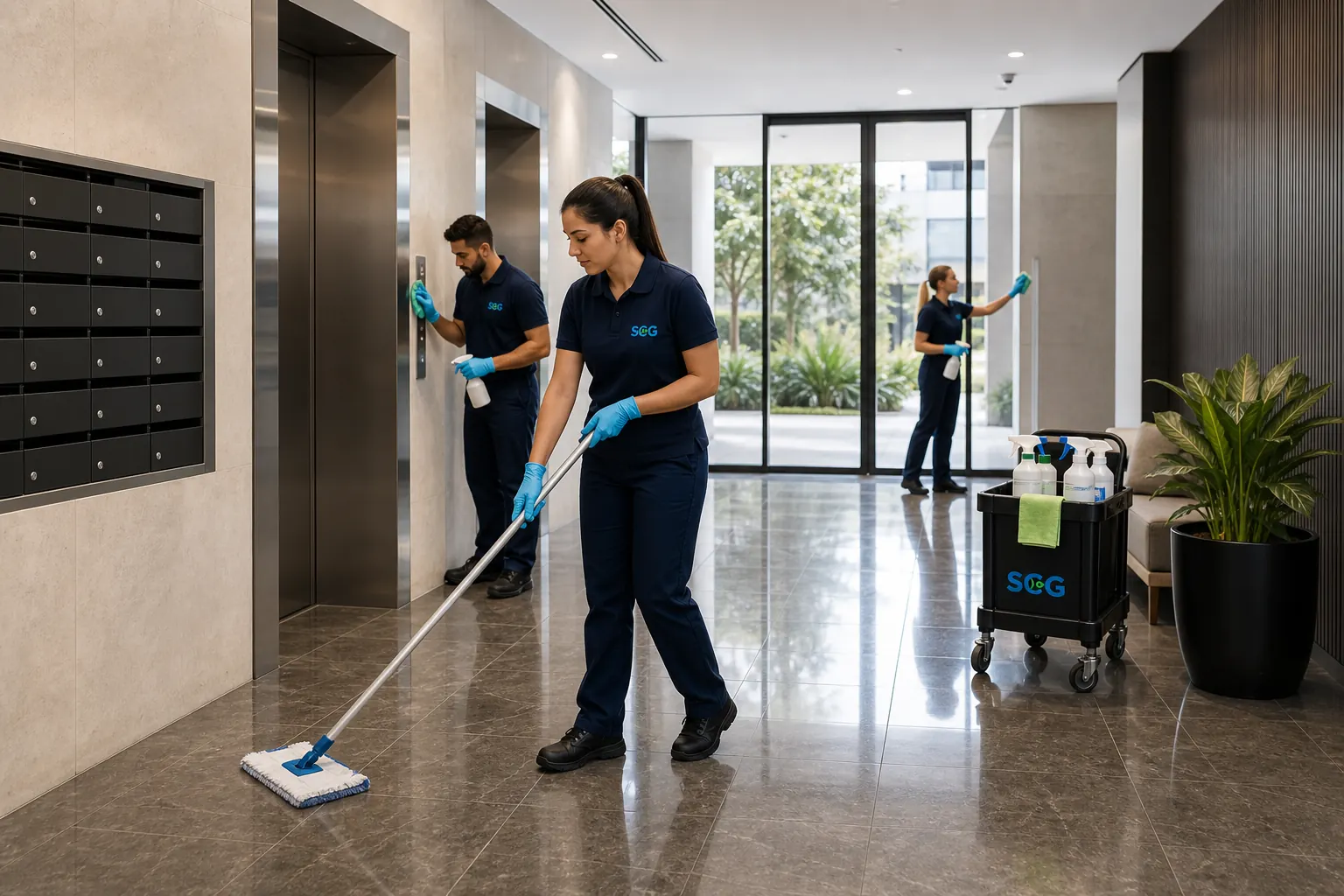
The building, not the tenancy.
A tenancy clean covers what happens inside one business's leased space — desks, kitchenettes, meeting rooms. Building cleaning is a different scope entirely: it is the shared infrastructure every tenant, visitor and resident passes through to get there, and it belongs to the building owner or the managing agent rather than any single tenant.
That means the entry foyer and lobby, the lift cars and lift lobbies on every floor, fire stairwells, basement and undercroft car parking, loading docks, bin and compactor rooms, plant room access corridors, and the external hard surfaces around the building's entry points. None of it is inside a tenant's lease line, and all of it forms the first and last impression anyone has of the property.
This is different from strata cleaning in one important way: strata cleaning is contracted by an owners corporation on behalf of unit owners under strata title. Building cleaning as covered here applies more broadly — to commercial office buildings, mixed-use towers, and any base-building arrangement managed directly by an owner or a managing agent rather than through a strata committee.
Where the building is under strata title, the cleaning contract is usually arranged by the owners corporation rather than a single owner — see how an owners corporation scopes common property for how that tendering process typically works.
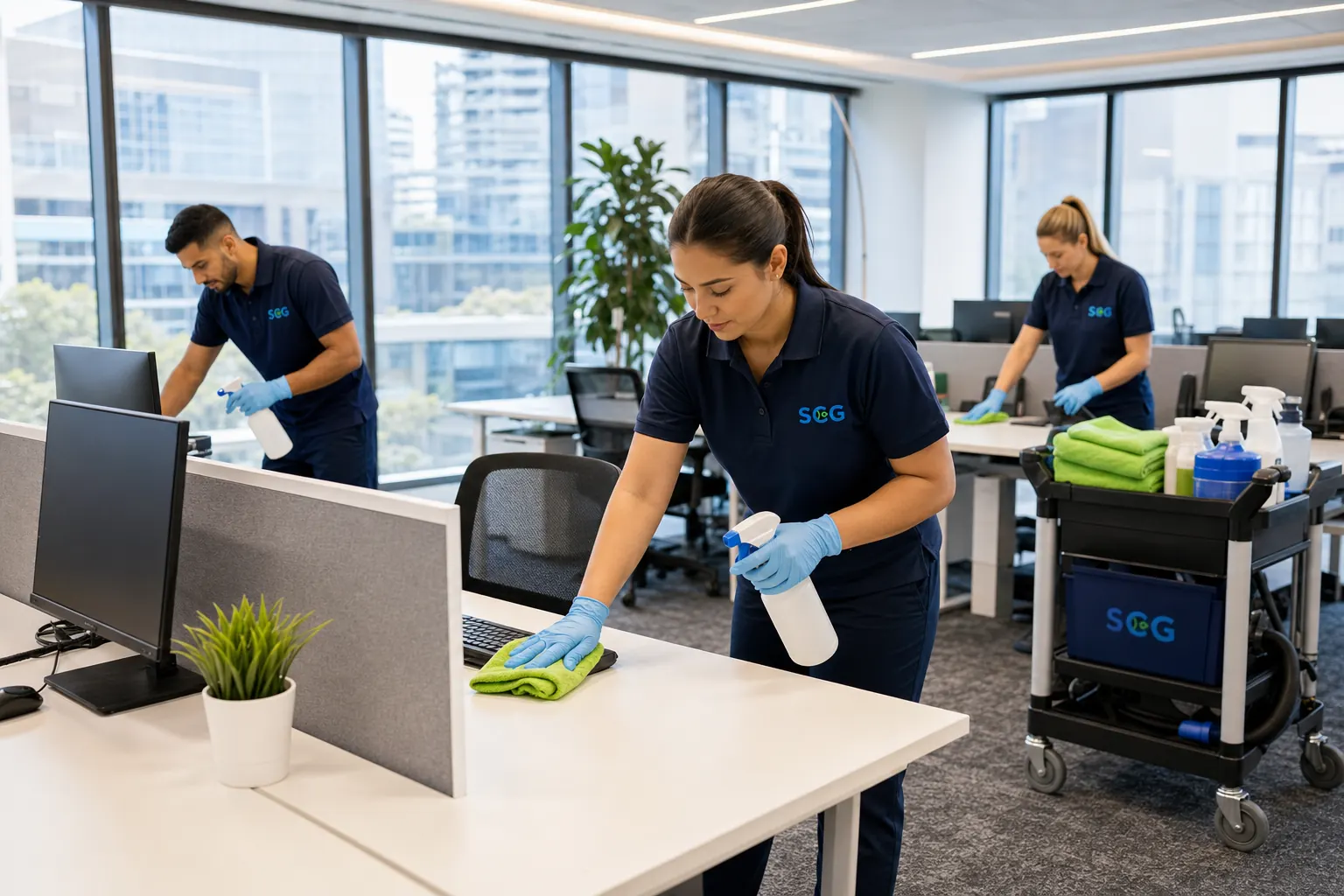
What building cleaning covers.
Lobbies & Foyers
Entry glass, floors, directory boards and seating areas kept to a standard the building manager can point to on any given day.
Lifts & Lift Wells
Lift car floors, walls, mirrors and control panels, plus lift lobby presentation on every level the building has tenanted.
Stairwells
Fire stairs cleaned and kept clear as an egress path, not just a corridor — handrails, landings and door hardware included.
Basement Car Parks
Sweeping, oil-stain spot treatment and periodic scrubbing of basement and undercroft parking, including ramps and line marking visibility.
Bin Rooms & Compactors
Bin room floors, walls and compactor surrounds cleaned and deodorised on a schedule that keeps pest activity down.
Plant Room Access & External Hard Surfaces
Access corridors to plant and services areas, plus entry paths, awnings and external hardstand kept presentable and safe underfoot.
Why building managers use a dedicated base-building contract.
One Scope, One Standard
A single documented schedule for common property, rather than gaps between individual tenants' own arrangements.
Direct Relationship With Management
We report to the building manager or owner directly, with a schedule they can audit rather than an informal arrangement.
Presentation That Reflects On The Whole Asset
A well-kept lobby and lift bank affects leasing and resale value for the whole building, not just one tenant's impression.
Coordinated Access
Scheduling built around building access hours, contractor sign-in procedures and any base-building security protocol.
Whole-building cleaning versus a single tenancy
The clearest way to separate the two is to ask who signs the contract and what it's for. A tenancy clean is paid for by one business, covers the space inside its lease line, and stops at the tenancy door. Building cleaning is paid for by the owner or the managing agent, covers everything a tenant doesn't own, and applies to the whole property regardless of how many businesses occupy it.
In practice this means a single building can run two entirely separate cleaning arrangements at once — several tenants each with their own office cleaner, and one building-wide contractor responsible for the lobby, lifts, stairs and car park those tenants all share. Confusing the two is a common and costly mistake: a tenant paying for lobby presentation they don't control, or an owner assuming a tenant's cleaner is covering the fire stairs when nobody has scoped that work at all.
Lobbies, lifts and the first impression
A building's lobby and lift bank are seen by every visitor, every tenant, every prospective tenant on a leasing tour, and every valuer during a sale process — far more often than any single tenancy is seen by an outsider. Entry glass smudges and scuffed lift floors are noticed within seconds, which is why lobby and lift presentation typically runs on a daily or near-daily schedule even when the rest of the building is serviced less often.
Lift cars need particular attention because they are a small, enclosed, heavily trafficked space — floor marks, fingerprints on control panels and mirror smudges accumulate fast relative to the square metreage involved. We schedule lift servicing to hit peak-traffic recovery windows, typically early morning before the building fills, rather than once a week regardless of use.
Stairwells: an egress path, not a storage corridor
Fire stairwells are easy to neglect because tenants rarely use them day to day, but they carry a compliance dimension beyond appearance — they are the building's emergency egress path and need to stay genuinely clear, not just swept. Cleaning stairwells properly means checking handrails, landings, door closers and signage as well as the floor surface, and flagging anything obstructing the path rather than cleaning around it.
Because stairwells see infrequent foot traffic but accumulate dust and cobwebs steadily, they are usually scoped on a periodic rather than daily cycle — weekly to fortnightly is common for a mid-rise commercial building, with more frequent attention in stairwells that double as a smoking or break area despite building rules against it.
Basement car parks and bin rooms — the areas nobody photographs but everyone smells
Basement and undercroft car parks accumulate oil drips, tyre marks and general grime that a monthly sweep alone won't manage, and dim lighting means residents and tenants notice smell and stickiness underfoot before they notice a visual problem. Periodic mechanical scrubbing, oil-stain spot treatment and line-marking checks keep the space safe and presentable rather than merely swept.
Bin rooms and compactor surrounds are the single area most likely to generate a pest or odour complaint if neglected, because organic waste, moisture and warmth are exactly what attracts vermin and insects. A building-wide contract typically schedules bin room cleaning and deodorising on a frequency tied to collection days, so the room is cleaned when it's emptiest rather than when it's most full.
Coordinating with the building manager
Because building cleaning touches every tenant's experience of the property without any single tenant controlling it, the working relationship runs through the building or facilities manager rather than an individual business. That means agreed access hours, a sign-in process for contractors, and a documented schedule the manager can hold us to and can show an owner or a strata committee on request.
We provide certificates of currency for public liability and, where the building requires it, complete a contractor induction before the first service. Sydney Clean Group is based at 77 Garfield Street, Wentworthville NSW 2145. Call 02 9139 8401 to arrange a site walk with your building manager and a written base-building cleaning scope.
Building Cleaning Services Sydney — FAQs.
What is the difference between building cleaning and office cleaning?
Office cleaning covers the inside of one tenant's leased space. Building cleaning covers the shared infrastructure everyone uses to reach it — lobbies, lifts, stairwells, basement car parks, bin rooms and plant room access. A property commonly has both running as separate arrangements.
Who normally arranges building cleaning — the owner or the tenants?
The building owner or the managing agent, since common property doesn't belong to any single tenant. Where the building is under strata title, the owners corporation arranges it instead — see our strata cleaning services page for how that process works.
Do you clean basement car parks?
Yes — sweeping, oil-stain spot treatment, periodic scrubbing and line-marking checks for basement and undercroft parking, scheduled as part of a wider building cleaning contract.
How often are lobbies and lifts cleaned?
Usually daily or near-daily given how much traffic they carry and how visible they are to every visitor and prospective tenant. Lift servicing is often scheduled for early morning ahead of peak building traffic.
Do you handle bin room and compactor cleaning?
Yes. Bin rooms and compactor surrounds are cleaned and deodorised on a schedule tied to collection days, which is the single area most likely to generate a pest or odour complaint if neglected.
Can you work with our building manager rather than individual tenants?
Yes — that's the standard arrangement for building cleaning. We report to the building or facilities manager, work to agreed access hours and contractor sign-in procedures, and provide a documented schedule they can audit.
How much does whole-building cleaning cost in Sydney?
It depends on the building's size, the number of common areas, car park size, and frequency required. We quote from a written scope after a site walk with the building manager rather than a flat per-square-metre rate. Call 02 9139 8401.
Related common-property and commercial services.
Common property cleaning under NSW strata title arrangements.
What the interstate term means and how it maps to NSW strata.
How hourly rates are generally structured for building work.
For a single tenancy rather than shared building infrastructure.
Get a base-building cleaning scope for your property.
Site walk with your building manager, a written scope, and a schedule that covers lobbies, lifts, stairs, car park and bin rooms.